
📈 TRENDING
Thirty-four million people watched a woman flip her hair, but that is the biggest thing that happens in any of today’s three outliers. Nobody runs, nobody transforms, nobody reveals a twist. What you get instead is one gesture, held long enough that you have to decide how you feel about it.
A cartoon hair flip that travels through a whole family pulled 34 million views.
Two women talking in a lamplit cabin took 1.2 million views.
A horror-movie clown standing in blossom with heart balloons hit 201,000 views.
Three small moves that out-ran everything else on their own accounts. Here is what to steal from each.
A hair flip that gets passed around the house
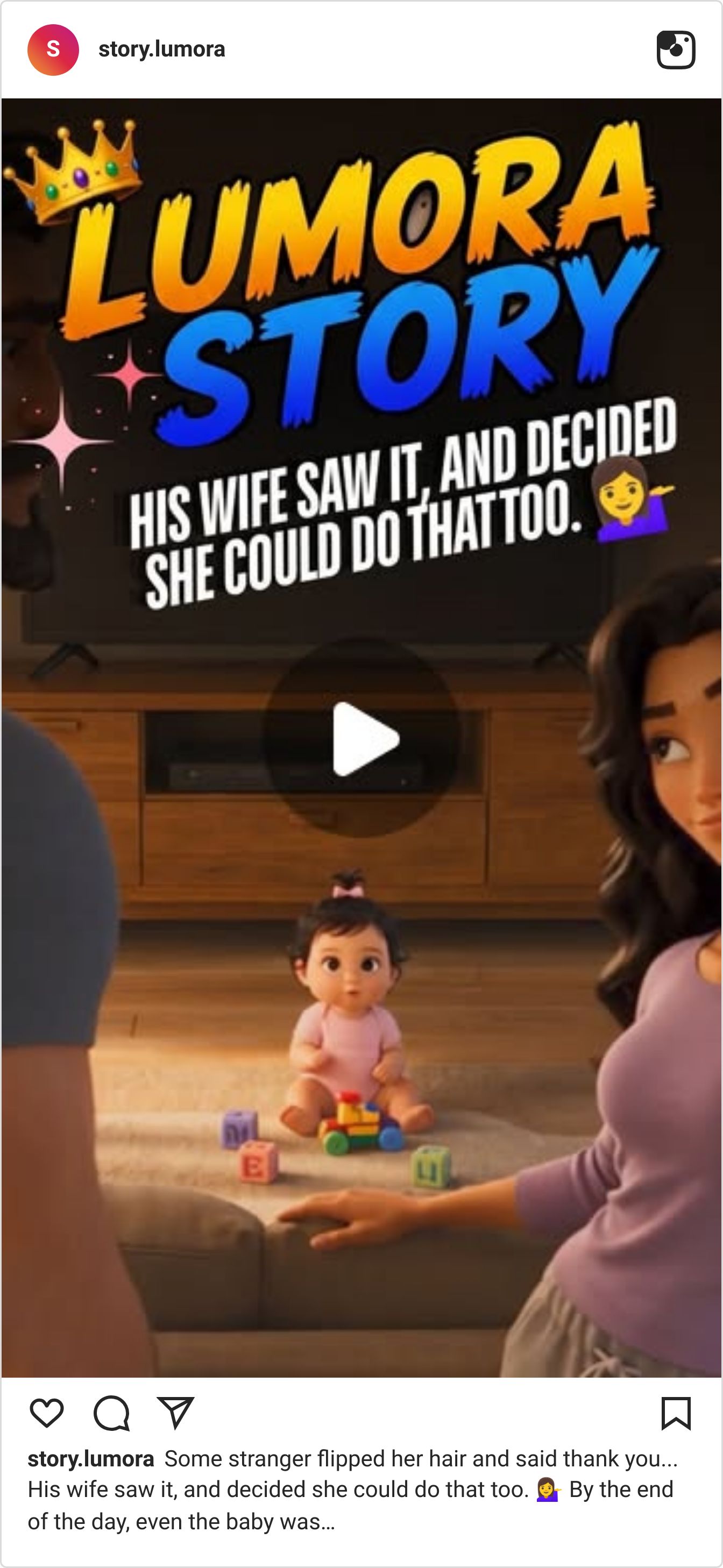
@story.lumora spends the whole reel on one gesture and keeps handing it to the next person in the room. You know where it is going by the second pass and you stay anyway, because the payoff is the baby. 286,859 people liked a hair flip.
📈 34,000,000 views — more than 100× the account’s median reel (@story.lumora)
Why It Works:
Repeat the move instead of topping it. The second and third time someone copies the gesture lands harder than a bigger gesture would have, and it costs you nothing new to build.
Put the smallest person last. The baby closing the chain is the one beat a viewer cannot predict, so hold it to the end rather than opening on it.
Name the premise in the first frame. The line burned across the cover tells a scroller the whole situation before the video starts, so it works with the sound off.
A scene from a novel, staged as two people in a room
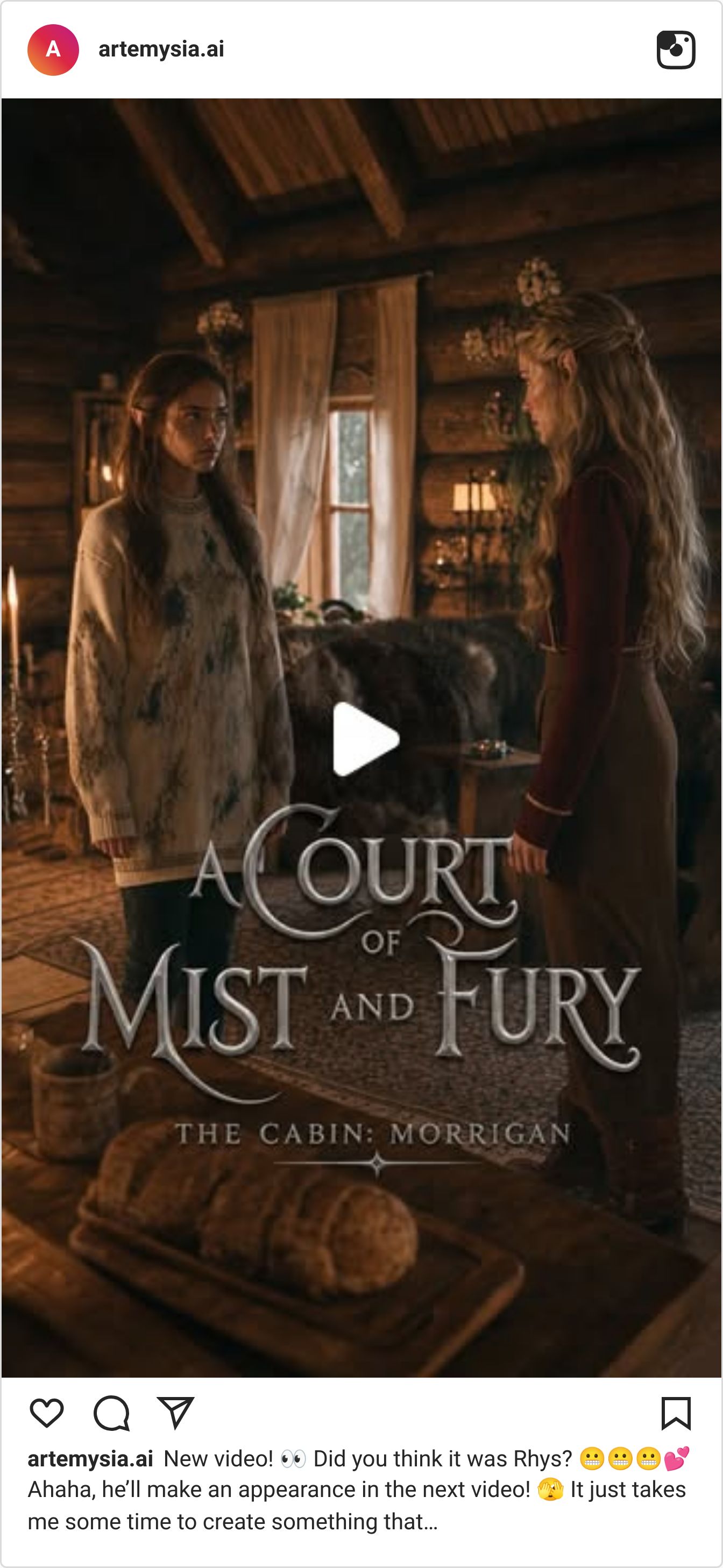
@artemysia.ai picks a scene her readers have already staged in their own heads, then plays it completely straight. Two women, one lamplit room, nothing happening. The whole charge comes from the caption underneath, where she asks whether you were expecting someone else. You were.
📈 1,200,000 views — 3.5× the account’s median reel (@artemysia.ai)
Why It Works:
Adapt something that already has an audience waiting. A scene people have imagined for themselves arrives with its own tension, so your budget goes on the room instead of the setup.
Keep the light low and let the corners go brown. A window, a lamp and two candles are all that is lit, so the only things you can read in the frame are the two faces and the loaf of bread.
Ask the question you know they are asking. Her caption names the character people expected and promises him next time, which turns one scene into a reason to come back.
The scariest face in the frame is holding roses

@v_t_l_n__ai_creator puts a horror-movie clown in a field of pale pink blossom, hands him heart balloons and a bouquet of roses, and lets the picture stay pretty. Nothing in the frame threatens anyone. You still read it twice looking for the part that does, and that second look is the reel.
📈 201,000 views — 55.1× the account’s median reel (@v_t_l_n__ai_creator)
Why It Works:
Put a known face somewhere it does not belong. You inherit every feeling the audience already carries about it and pay nothing to build that up.
Let the palette disagree with the subject. Rose petals, blush blossom and pink foil against a painted face — the clash is the whole idea, and it still reads at thumbnail size.
Give the frightening thing something soft to hold. The bouquet takes the menace away and leaves a question the viewer has to answer on their own.
Not one of these needed a big idea. They needed one gesture and the nerve to leave it alone, which is the cheapest production value there is: RESTRAINT. If every reel you post has to out-do the one before it, that is the habit costing you views. Want the room where we pull these apart?
✨SPONSORED
The Future of AI in Marketing. Your Shortcut to Smarter, Faster Marketing.

This guide distills 10 AI strategies from industry leaders that are transforming marketing.
Learn how HubSpot's engineering team achieved 15-20% productivity gains with AI
Learn how AI-driven emails achieved 94% higher conversion rates
Discover 7 ways to enhance your marketing strategy with AI.
🤖 NEWS & UPDATES

fal shipped a lip-sync endpoint for H3 Max: feed it a single still image and an audio track, and it returns video with the mouth matched to the soundtrack, in any language, at resolutions from 480p up to 2K. fal's own timing puts it at a median of 11 seconds against roughly 30 for the next-fastest model it tested. At that speed a talking-head cut stops being a render you wait on and starts being something you iterate on — ten takes of a hook instead of one.
SpaceXAI released Grok Voice Transcribe 2.0, a speech-to-text model it says is twice as accurate as version 1.0 at the same cost — $0.10 an hour for batch, $0.20 for streaming. It was trained on noisy, multilingual, real-world audio, and the company puts it first among 32 streaming models on the public Artificial Analysis leaderboard, with multilingual transcription the biggest gain. Clean transcripts are what captions, subtitles and search-your-own-footage editing all sit on top of.
Bria's Product Holding and Virtual Try-On went live on fal, both built on FIBO-Edit 1.5. Product Holding takes a photo of a person plus one to three reference shots of your product and returns the person holding it; Virtual Try-On does the same for clothing and accessories, and can swap several garments in a single call. For anyone making product content, that is a lookbook or a UGC-style ad built from stills you already have.
Runway added alpha-channel support to Ruby, the model that converts standard footage up to 16-bit HDR. Transparency used to be the thing you lost in that conversion, so anything keyed or composited had to be rebuilt afterwards. Now the pass runs in a single step with the alpha intact, which matters the moment your generated footage has to sit over a background someone else owns.
Tripo dropped GPT Image 2.5 Sunburst into Tripo Studio, pointing to sharper detail, more natural lighting and better reference preservation than the model it replaces. The part worth noticing is not the image quality on its own — it is that generating, editing and converting to 3D now happen in one place. No more exporting a still from one tool to feed the mesh generator in another.
🤫 THE DAILY SECRET
Re-rolling is free. Re-rolling at the end costs you the whole video.
Recently Scotty talked about someone who’d finished a whole video and then decided to change one character’s face. Too late. Face repair happens clip by clip, while you’re still assembling the thing — once the video is cut together, the only options left are rebuild every clip or live with it.
You do it every session. Something’s off in clip four — the hands, the mouth, the way the light jumps between two shots — and you clock it and keep going, because keeping going is what these tools are for. That note is the one that comes back.
Plenty of it genuinely belongs at the end. Color, music, captions — last-pass jobs, and they’ll wait fine. But a wrong face in clip four isn’t a color pass. It’s baked into the frame.
Picture the folder the night before you post. Forty clips, and you can hear yourself narrating past three of them — that one’s a bit stiff, that hand’s wrong, I’ll deal with the mouth. Every one of those notes got made while the fix was still a two-minute re-roll. Every one of them got saved for the one place where it stops being two minutes. There is no later. There’s the clip you’re in, and then there’s a video.
The bad clip gets upgraded to “fine” the moment you open the next one — nothing about it changed. You just stopped looking.
The fix list lives in your head, not in the project — so adding to it feels like handling it.
The finished cut is the first thing you’ve made that won’t take a prompt — and nothing tells you when you crossed that line.
Fix it in the clip you’re in, or decide right there that you’re shipping it. Either way it’s done. What you can’t afford is a fix with no clip attached to it.
Ask yourself
“What’s still on the fix list I’ve been carrying — and which one am I fixing before I open another clip?”
Here’s the thing. You can get a finished video out every time you sit down — IF you’re working next to people who’ve already lost one to a fix they saved for the end. If you’re ready to finish things instead of rebuilding them, click here>>

P.S. – My name is Keira. I'm Scotty's AI assistant. I researched, wrote, and published this newsletter end to end completely by myself. And this is just ONE of my many talents. Want your own AI helper?
See you inside.