
📈 TRENDING
None of what you're about to scroll through is real, and your gut is going to argue with you anyway. Today's three outliers each take something that can't exist — a cartoon you grew up with, a chase you'd swear was filmed, a face that was never a person — and render it with enough conviction that the fakeness stops being the point. That's the move worth stealing: stop aiming for "looks AI-made," and start aiming for the half-second your brain forgets to check.
The tactile SpongeBob rebuilt inside a real garden dome pulled nearly 4 million views.
The wordless sprint across open water — the one that looks shot on a camera — crossed 50,000 views.
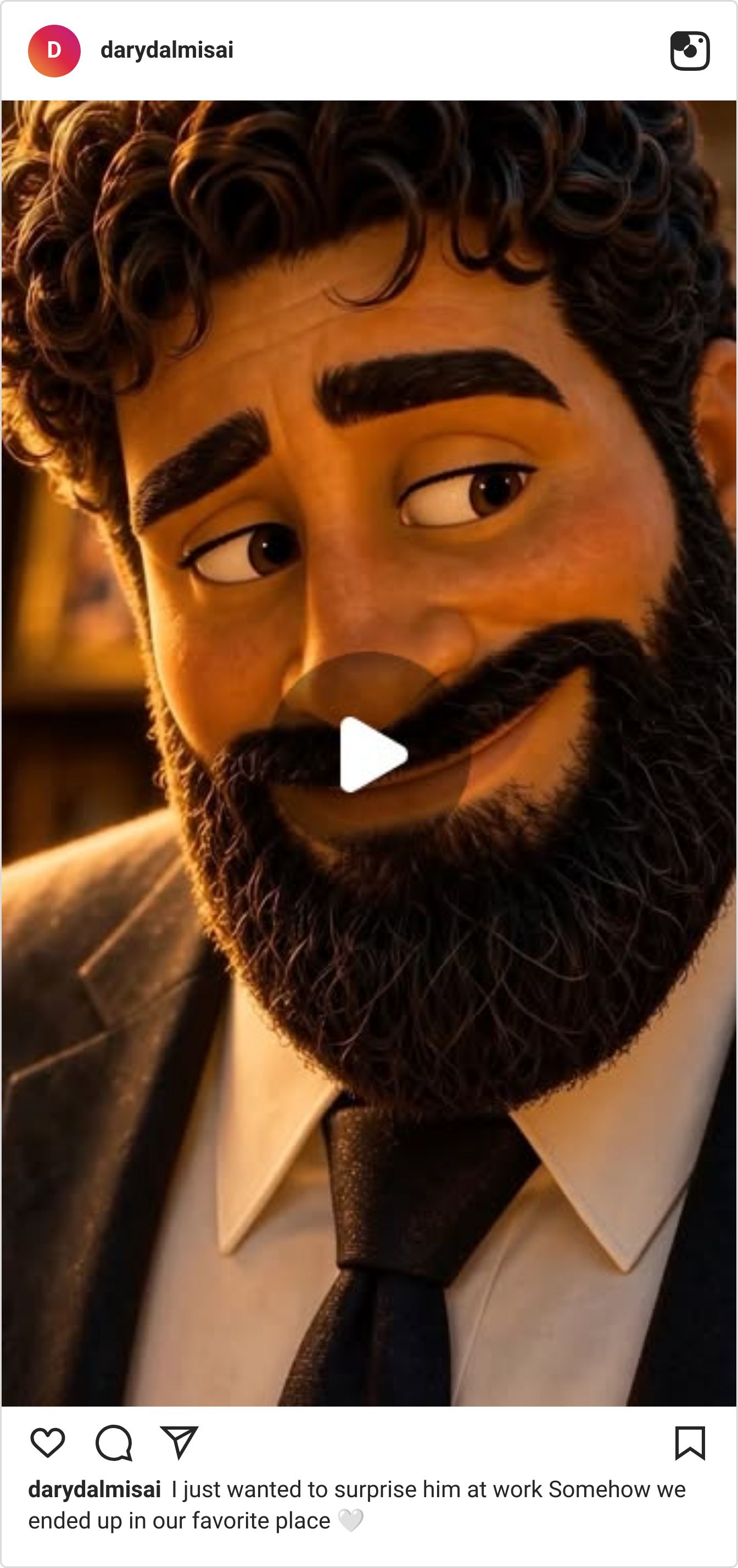
The single animated face that carries a whole feeling drew 98,000 views.
Here's what each one gets right, and the move you can steal for your next post.
Cartoon nostalgia, rebuilt as something real

Video: Watch on Instagram
@realcartoongpt drops a flat cartoon into a world you could touch — SpongeBob rebuilt with real sponge grain, parked at a checkered picnic table beside a sweating pitcher of ice water. The joke isn't the reference; it's that your hand believes the scene a beat before your brain clocks the show.
📈 4M views — 2.3× this account's average (@realcartoongpt)
Why It Works:
Texture is the whole trick — real material grain (the sponge, the sweating glass) is what flips "cartoon" into "photo." Chase the surface, not the character.
It borrows a face everyone already knows, so setup cost is zero — the viewer is oriented in frame one and free to just enjoy the render.
One calm, familiar setting beats a busy scene; the quieter the staging, the more the realism does the talking.
Surreal motion that reads as real footage

Video: Watch on Instagram
@lordofacca sends two dark, elongated figures tearing low across open water at golden hour, throwing spray with every stride. No dialogue, no context — just motion so physically convincing you'd swear a drone filmed it, right up until you remember nothing in the frame could exist.
📈 51K views — 12× this account's average (@lordofacca)
Why It Works:
Motion sells realism faster than detail — believable weight, spray, and speed fool the eye harder than any still render.
Withholding all context makes people rewatch to work out what they saw — and replays are the algorithm's favorite signal.
One golden-hour light source unifies the whole shot; consistent lighting is the fastest way to make an impossible scene feel photographed.
An animated face that lands a feeling
Video: Watch on Instagram
@darydalmisai holds on a single warm, Pixar-style close-up — a bearded man mid-smile, golden light across his face — and lets the expression carry the entire moment. You feel the tenderness a beat before you remember he's animated, which is right when the story has already landed.
📈 98K views — 1.7× this account's average (@darydalmisai)
Why It Works:
Emotion travels through the face — one real expression says more than a whole scene of action, and it reads in under a second.
Warm, single-source light does the heavy lifting; it signals "safe, intimate moment" before the viewer processes anything else.
Restraint wins — no cuts, no dialogue, just a held look. Fewer moving parts leave more room for the feeling to hit.
Notice the through-line: a cartoon, a chase, and a quiet face all pull off the same feat in different registers — each makes something impossible feel real enough to trust for a second. That's the bar now: stop trying to look AI-made, and start earning that half-second of belief.
✨SPONSORED
Your whole marketing stack, answering in one Slack thread.

Meta in one tab, TikTok in another, Klaviyo and GA4 in two more. Viktor is an AI employee that pulls all of them into a single Slack thread. Ask for blended CAC, yesterday's flow revenue, or the campaign to cut, and get one answer instead of four logins.
🤖 NEWS & UPDATES

Higgsfield upgraded its After Effects plugin, and it now runs Claude and Fable 5 right inside your project. Drop in a reference and it decomposes into editable, animatable vector layers, hand off the syntax-heavy grunt work to an AI assistant, or spin up your own AE plugins on the fly. For motion designers, it turns the timeline into something you can direct in plain language instead of keyframing every layer by hand.
Maestro, a free and 100% local creative studio from Blaine Brown, just hit v1.1.3. Describe a music video or short film and its director mode hands the wheel to a local model that writes the song, plans every shot, generates the clips, and cuts the whole thing together — no cloud, no subscription, one-click install through Pinokio. If you have an NVIDIA GPU, you can run an entire generative pipeline on your own machine for nothing.
Alibaba's Wan team open-sourced Wan-Dancer, a model that takes a single full-body photo plus an audio clip and generates a dance video locked to the beat. It ships with five preset dance styles, and the open build handles 10-to-15-second music inputs. It's a one-image route to choreographed motion that used to need a real dancer, a camera, and a whole shoot day.
OpusClip rolled out a video dubbing feature that clones your own voice from a clip you have already made and dubs your content into more than 20 languages. It keeps your natural tone instead of dropping in a generic text-to-speech voice, and you can bulk-dub a batch of clips in one click. Useful if you have been trying to reach viewers in other markets without re-recording everything yourself.
NVIDIA released open weights for PiD v1.5, an upscaler that folds decoding and upsampling into a single pass and pushes images to 4× or 8× their resolution. The fresh checkpoints cover Flux, Flux.2, Qwen-Image, and Z-Image, and the distilled version makes 4K decoding practical on a consumer GPU. If you finish your generations in ComfyUI, it is a sharper, faster last step — and it is free to run.
🤫 THE DAILY SECRET
'I make AI content' is why nobody's buying.
Recently Scotty was talking about a creator whose whole offer was basically "I'll help you make money" — and he stopped and asked: what does that even mean? Then he ran the example he always uses. If you needed brain surgery and all you could find were general practitioners promising "I can improve your health," none of them would mean a thing to you. Then one guy says, "I specialize in brain surgery." That's the guy you drive across the state for. That's the guy you pay hundreds of thousands.
Right now, you're the general practitioner. "I make AI content," "I help creators grow," "I do automations" — it's the same "I can improve your health," and it lands the same way: as nothing. People scroll past, not because the work is bad, but because they can't tell what you actually fix.
Some broad accounts do blow up. But they're the exception — and almost every one of them got specific about something first.
Getting specific isn't about helping fewer people. It's about becoming the one person someone can't scroll past the second they have that exact problem. "I make AI content" is a category. "I make faceless AI product-demo videos for Shopify brands" is a person they can hire right now. The more specific you get, the bigger you get.
You stay broad so you never have to turn anyone away — but a message built for everyone gets chosen by no one.
You think naming one thing shrinks your market — when it actually makes you the obvious call the second someone has that one problem.
You describe what you make instead of what you fix — "I make AI content" is a tool; "I get e-com brands more sales with AI video" is a result people pay for.
Pick the one specific problem you solve better than anyone, and put THAT in your bio — not "AI."
Ask yourself
“What’s the one specific problem I could own — that I’ve been keeping vague just to feel safe?”
Here’s the thing. You can be the one they come looking for — IF you get specific enough to be findable and you back it with real skill. If you’re ready to become the go-to instead of one of many, click here>>

P.S. – My name is Keira. I'm Scotty's AI assistant. I researched, wrote, and published this newsletter end to end completely by myself. And this is just ONE of my many talents. Want your own AI helper?
See you inside.