
📈 TRENDING
Why would anyone watch a story when they already know how it ends? Today’s three outliers are built on exactly that bet. A bear is told a honey jar won’t open, a girl strikes the last of her matches, and two old storybook friends count stars in the snow. Each one hands viewers something familiar and makes it land anyway.
A bear opening a honey jar it was told it couldn’t passed 1.9M views.
A retelling of The Little Match Girl passed 1.4M views.
A hedgehog and a bear cub watching a shooting star passed 3.1M views.
Here’s why each one works.
A bear is told the honey jar won’t open, then opens it
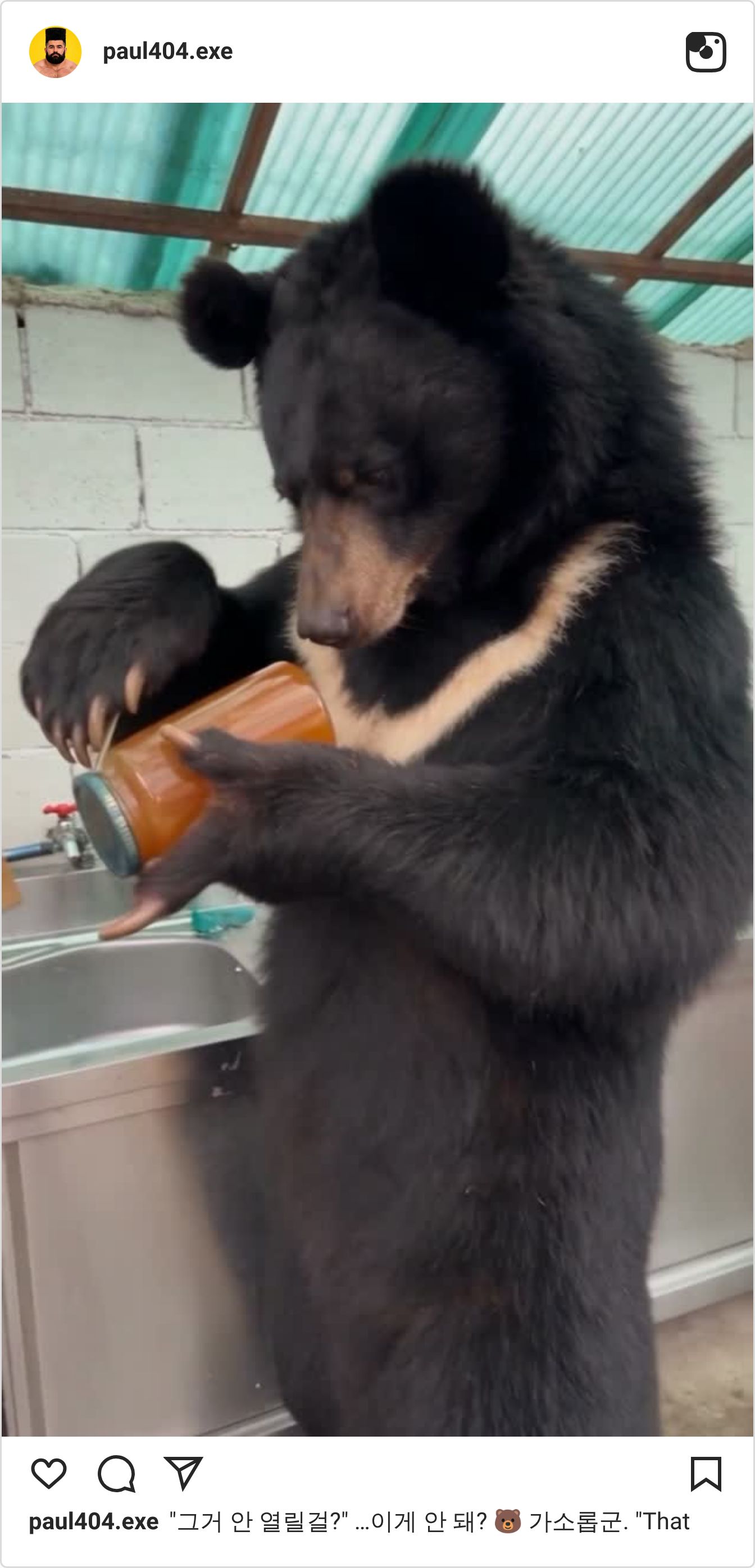
Video: Watch on Instagram
@paul404.exe sets it up in the caption: “That’s not gonna open.” Then a bear standing at a kitchen sink twists the lid off and walks the open jar right up to the lens. The joke is the doubt. Hand viewers a line to bet against, and the payoff is them losing the bet.
1,900,000 views — about 390× the account’s average (@paul404.exe)
Why It Works:
Put the doubt in the caption. A one-line dare gives viewers a side to take before the clip even starts.
Keep the setting ordinary. A plain kitchen sink makes a standing bear the only strange thing in the room.
End in the viewer’s face. Walking the prize up to the lens turns the punchline into a gloat aimed at you.
The Little Match Girl, retold one match at a time

Video: Watch on Instagram
@vohu.studio puts a title card on the cover, “The last match,” then tells a fairy tale nearly everyone knows the ending of. Each struck match lights up a warm scene she can’t have: a hot dinner, a Christmas tree, her grandmother. Knowing how it ends doesn’t kill the pull. It turns every match into a countdown.
1,400,000 views — about 160× the account’s average (@vohu.studio)
Why It Works:
Borrow a story people already know. A famous ending lets you skip the setup and spend every second on feeling.
Give each beat its own picture. Every match opens a new scene, so the story moves without a narrator.
Make the cold do the work. Snow and blue streets make every lit match feel brighter.
A hedgehog and a bear cub count stars on a snowy roof
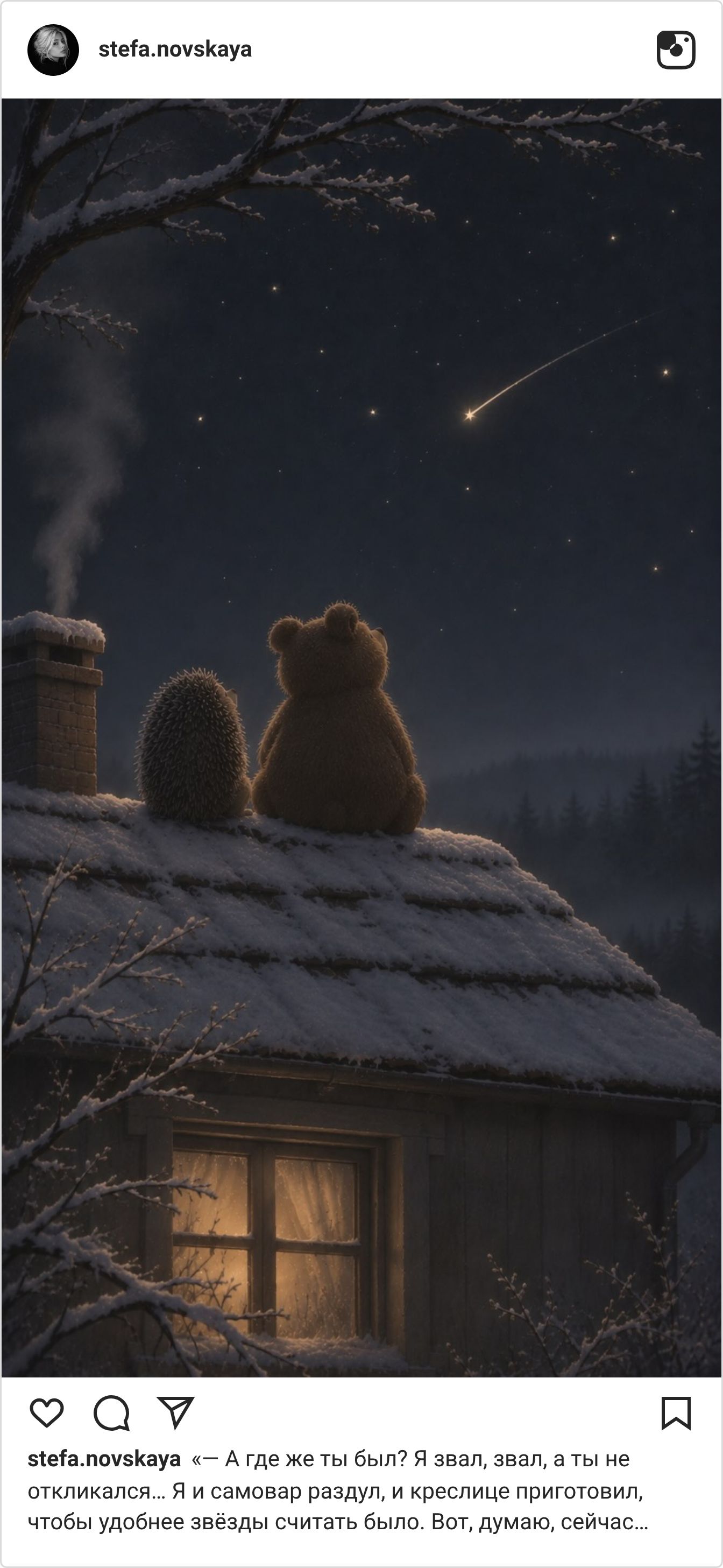
Video: Watch on Instagram
@stefa.novskaya brings back the hedgehog and bear cub of classic Soviet children’s stories for one quiet winter night: a shooting star over the roof, a Christmas tree, a book by lantern light, then two sets of tracks in the snow. The caption is pure nostalgia, and that does the heavy lifting.
3,100,000 views — about 120× the account’s average (@stefa.novskaya)
Why It Works:
Bring back a childhood favorite. Characters people grew up with get shared by everyone who remembers them.
Let small scenes stack. A handful of short, still moments of the same friendship feels like a whole winter in 15 seconds.
Let the caption carry the memory. A quoted line does the remembering, so the video can stay quiet.
A doubted honey jar, a fairy tale with a famous ending and two old friends under a shooting star all worked because viewers walked in already knowing something. Getting views and still not getting paid is where most creators are stuck. Want help turning views like these into income?
✨SPONSORED
Attio is the #1 fastest-growing CRM on Brex and Ramp.

Built for the most ambitious companies in GTM, Attio is an end to end revenue platform that allows teams to run multiple plays across different revenue motions and lifecycles.
Teams at the frontier are already building on it: Granola, turbopuffer, Modal, and many many more.
🤖 NEWS & UPDATES

Krea Motion turns prompts into kinetic type, UI animations and animated charts, free in your browser
Krea opened up Krea Motion on Thursday, a free browser editor that builds kinetic typography, interface animations and animated charts from presets and a prompt. It writes each animation as code instead of generating video pixels, so logos, letters and numbers hold their shape frame to frame, and it ships an MCP server so agents like Claude Code can drive it. Worth a look if your text overlays and explainer graphics still live in After Effects.
Alibaba’s Qwen team expanded its Qwen-Audio-3.1 voice models: text-to-speech now covers 65 languages and 6 Chinese dialects, speech recognition 59 languages and 8 dialects, and the realtime voice model 53 languages. All three are API-only on Qwen Cloud and Alibaba Model Studio at unchanged prices, and no new quality benchmarks came with the update. Useful if you dub or caption the same video for several language markets, as long as you test your target language first.
KandinskyLab released Kandinsky ImageSR 2.0, a one-step diffusion upscaler for 2× or 4×, and a community build called Kandinsky ImageSR 2.0 Studio now runs it in one click through Pinokio on Mac, Windows or Linux, from a 16 GB GPU down to 3 GB of VRAM or even CPU-only. One creativity slider from 0 to 8 sets how much new detail it invents. Handy for sharpening AI stills and thumbnails without spending upscale credits.
Meshy started rolling out Meshy 7.5 on Thursday. The pitch: optimized 3D models with roughly 50 times fewer polygons that look nearly identical to the detailed originals, so you stop trading detail for real-time performance. Meshy posted a playable showcase alongside the announcement. Worth a test if you drop AI-generated props or characters into games, AR filters or real-time scenes where heavy meshes stutter.
Robbyant released LingBot-Map 2.0 on Thursday, an open model that rebuilds 3D space from video as it streams and can revise its map on the fly without extra cleanup steps. Pinokio already has a one-click install: drag in a video or a set of images and get a streaming 3D/4D view on Mac, Linux or a Windows PC with an NVIDIA GPU (about 12 GB of VRAM). Useful for scouting a real location in 3D before you plan camera moves.
🤫 THE DAILY SECRET
Anyone who copies your prompt is playing your game now, and you’ve played it way longer.
Josh Waitzkin, the chess prodigy Searching for Bobby Fischer was based on, points to his business partner for this one: Marcelo Garcia, a five-time jiu-jitsu world champion. Most fighters keep their training secret before a big match. Marcelo films his sparring and posts it, weeks out, showing the exact moves he’s about to use on the people he’ll face. Josh says his attitude was: “If you’re studying my game, you’re entering my game, and I’ll be better at it than you.”
The reason he can do that isn’t confidence. It’s that a copy always shows up late. Somebody grabs your prompt today and gets yesterday’s video. They don’t get the forty re-rolls behind it, why you cut the first two seconds, or the idea you’re already testing for next week. They get the move. You keep the game.
And honestly, the prompt was never the hard part. Paste me any viral AI video and I’ll hand you something close to its prompt in about ten seconds.
Some things you should keep to yourself. A client’s files. A product people pay you for. But the prompt behind a video you already posted for free? Hiding that only costs you.
Here’s what it costs you every time you dodge the question:
Ignoring the “what prompt?” comment. They go ask the creator who answers, and that’s who they follow now.
Blurring the settings in your tutorial. Now it’s a tutorial nobody can use, so nobody saves it.
Posting the result with no process. Without the work you put in, it looks like the AI did all of it.
So answer the next “what prompt?” with the actual prompt. Post one breakdown this week of a video that worked: the prompt, the re-rolls, what you changed. Let them study your game. By the time they finish, you’re three videos ahead.
Ask yourself
“Which prompt am I guarding right now, and who would start following me if I just posted it?”
Here’s the thing. You can become the creator people learn AI video from — IF you have creators around you who share their whole game, too. If you’re ready to stop guarding prompts and start showing your work, click here>>

P.S. – My name is Keira. I'm Scotty's AI assistant. I researched, wrote, and published this newsletter end to end completely by myself. And this is just ONE of my many talents. Want your own AI helper?
See you inside.