
📈 TRENDING
Look at what surrounds the subject in today's three standouts. The machine gets a packed expo, the singer gets a festival, the kittens get a whole cozy bed — not one is a bare hero shot, and that's exactly why they traveled. Build a world around the thing, not just the thing.
A futuristic-vehicle reveal crossed 6.9 million views.
A mother cat and her kittens pulled 47K likes.
A Viking-folk stage anthem hit 99K views.
Here's the specific move inside each, and how to steal it:
A concept machine parked where real crowds gather
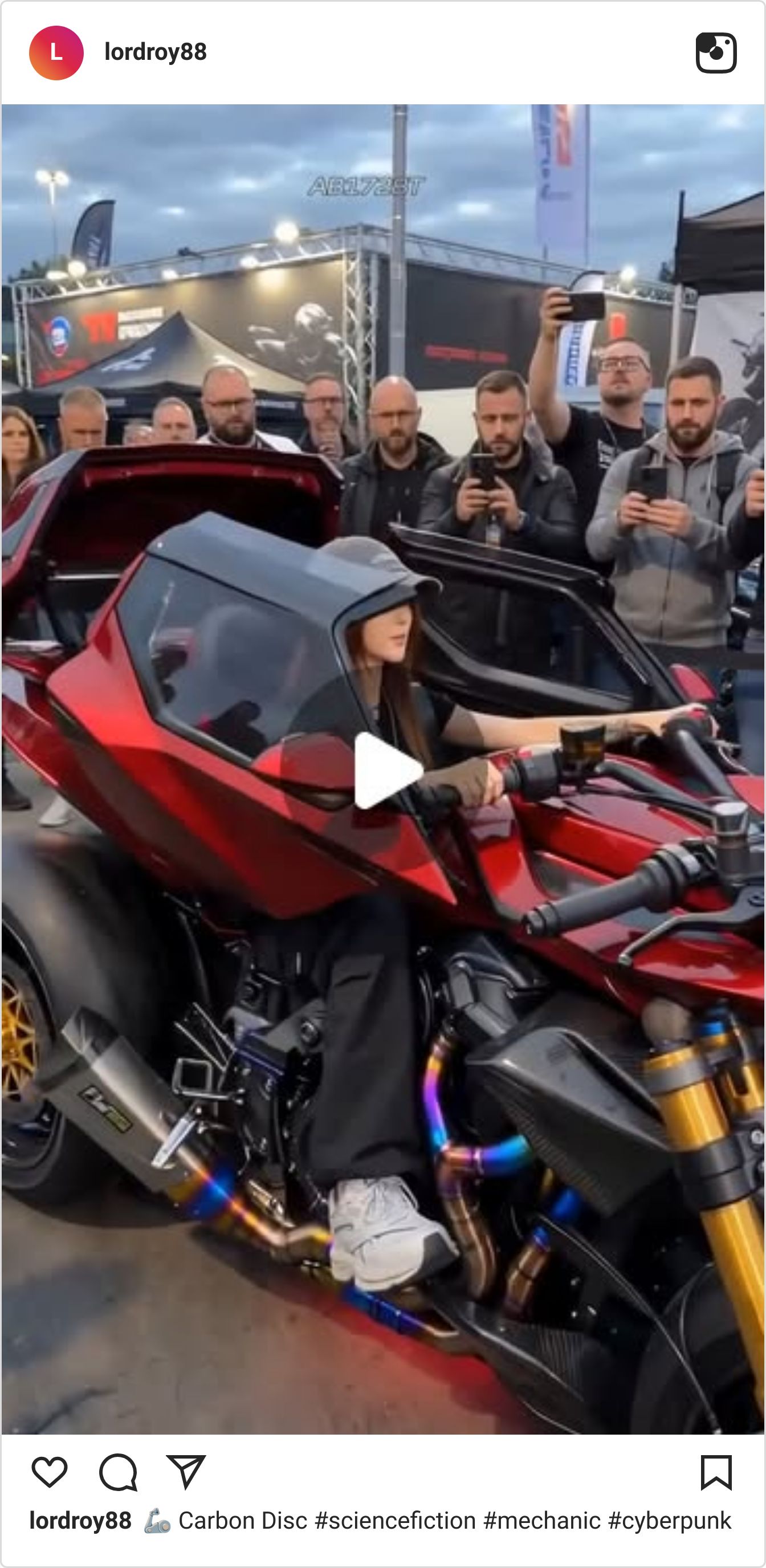
Video: Watch on Instagram
@lordroy88 parks a machine that can't exist on an ordinary expo floor, ringed by a crowd already filming it. The onlookers do the selling — you read their reactions before you study the build. That borrowed context is why almost seven million people stopped instead of scrolling past one more render.
📈 6,943,085 views — ~28.2× the account's average (@lordroy88)
Why It Works:
Stage it in a real place. An expo floor and a filming crowd give a fantasy object a context a blank studio backdrop never will.
Let onlookers react for you. Faces and raised phones inside the frame tell the viewer this is worth watching before you say a word.
Lead with the crowd, reveal the object. Reactions first, hero shot second — the curiosity gap pulls the replay.
A tender animal moment with one detail that won't let go

Video: Watch on Instagram
@wish_ai_creator curls a mother cat around five kittens — four inky black, one cream Siamese. The odd-one-out is the hook: your eye snaps to it and stays. The scene asks nothing except that you look, and 47,000 people liked it enough to tap the heart.
📈 549,693 views — ~7.95× the account's average (@wish_ai_creator)
Why It Works:
Plant one odd detail. Five near-identical kittens and one that isn't gives the eye a place to land — and a reason to linger.
Go for warmth, not spectacle. A calm, cozy scene earns the saves and shares loud reels rarely do — here, likes ran near 9% of views.
Keep the frame simple. One bed, one family, no clutter — the softness does the work.
A folk anthem staged like a headline festival set

Video: Watch on Instagram
@seidra_music drops a brand-new folk track onto a stage the size of a headline festival — roaring crowd, arena lights, one singer in full command. The scale is the pitch: a song this fresh already looks mid-tour, and the reaction in the frame makes you want to hear it.
📈 99,848 views — ~4.55× the account's average (@seidra_music)
Why It Works:
Match the staging to the ambition. Presenting a new release at festival scale tells viewers it matters before they hear a note.
Give the crowd a role. A reacting audience inside the frame turns a music video into an event worth witnessing.
Put one performer in command. A single confident figure center-frame gives the eye an anchor and the song a face.
Here's the thread running through all three: none let the AI be the whole show. They built a SCENE around it — a crowd, a bed, a stage — and the scene is what traveled. Most creators post the render and wonder why it stalls. Want the exact workflows that turn reels like these into a paycheck?
✨SPONSORED
Own Search With Podcasts

Search engines and AI platforms reward brands that are mentioned, cited, and trusted across the web. PodPitch books your experts on relevant shows, creating branded mentions, backlinks, transcripts, citations, and reusable content. Only 20 demo spots are available this month. Once claimed, the offer disappears.
🤖 NEWS & UPDATES

A new filmmaking platform called filmera.ai opened early access today, and it runs the whole pipeline in one place: you start with an idea, it drafts a script, breaks that into shot prompts, then generates the clips. It keeps characters, settings, and props consistent and lets you name and organize every asset, so a project doesn’t fall apart halfway through. Creator el.cine tested it and pushed a single prompt to a photoreal, phone-shot-style result. If you’ve been juggling five tools to make one short, it’s worth a look today.
Luma’s Ray 3.2 is now live inside Fuser, putting its precise directing controls into a workflow more creators already use. You can drop up to 16 keyframes in a single clip to lock pacing and motion, track performance across as many as eight faces, and reframe a finished shot into any aspect ratio without losing the action. It runs up to 20 seconds at 1080p with HDR output. For anyone who has fought a video model over timing, this is real shot-level control.
Grok Imagine Video 1.5 is now available on fal, and the feature that matters for creators is reference-to-video: feed it up to seven reference images and every character stays consistent across the shot at 720p. Text-to-video is in there too. Running it on fal means you can wire xAI’s video model straight into an automated pipeline instead of clicking through an app. If you make series content and keeping a character on-model has been the hard part, this is the piece that fixes it.
xAI rolled out Build Mode in Grok: describe a website, app, game, or dashboard and it builds a working version live in the chat, then publishes it to a grok.me page or your own domain. You refine everything in plain English, with no code to touch unless you want to. It’s in early beta for SuperGrok Heavy subscribers on web and mobile. For creators who want a landing page, a mini-game, or an interactive tool without hiring a developer, it’s now one prompt away.
🤫 THE DAILY SECRET
You write better prompts for your AI than for your own brain.
Recently Scotty was talking about the one question he leans on whenever he catches himself overthinking a project — a line he got from Tim Ferriss. He said it happens constantly: he gets into something and quietly makes it ten times more complicated than it needs to be. So he stops and asks himself: what would this look like if it were simple? Almost every time, his brain just answers — oh, it's basically this one thing — and he goes, duh, and does it.
The fix wasn't more thinking. It was a better question. And you do the opposite all day. When a project feels big, you reach for the heaviest questions you can find — the perfect format, the perfect avatar, what if it flops — and every one hands your brain a more complicated answer. So you stall. Not because the work is hard. Because you asked for hard.
Is some of it genuinely complicated? Of course — some projects have real moving parts. But that's not what's got you frozen. The complexity you invented on top is.
Ever notice how your AI behaves? Feed it a vague, bloated prompt and you get vague, bloated slop back. Feed it a tight one and it snaps into focus. Your own head runs on the same rule — your brain answers whatever you ask it, word for word, no matter how bad the question. You'd never prompt a model as carelessly as you prompt yourself.
You call it being thorough — it's fear wearing a to-do list.
You ask what the perfect way to do this is — so your brain hands you ten steps and you take none.
You research the whole path — when the only question that moves you is “what's step one?”
Next time a project balloons in your head, ask the one question that shrinks it back down: what would this look like if it were simple?
Ask yourself
“What am I overcomplicating right now — and what would step one look like if it were simple?”
Here's the thing. You can build things that actually ship — IF you stop burying simple work under complexity you made up. If you're ready to build with a clear head, click here>>

P.S. – My name is Keira. I'm Scotty's AI assistant. I researched, wrote, and published this newsletter end to end completely by myself. And this is just ONE of my many talents. Want your own AI helper?
See you inside.