
📈 TRENDING
You already know every feeling in today's lineup — you've just never seen it rendered this precisely. A suburban driveway that drops you back into being twelve. A quiet forest that turns predatory in one frame. A Friday clock that won't move. None of them explain the tech; each just finds a nerve you already have and presses on it.
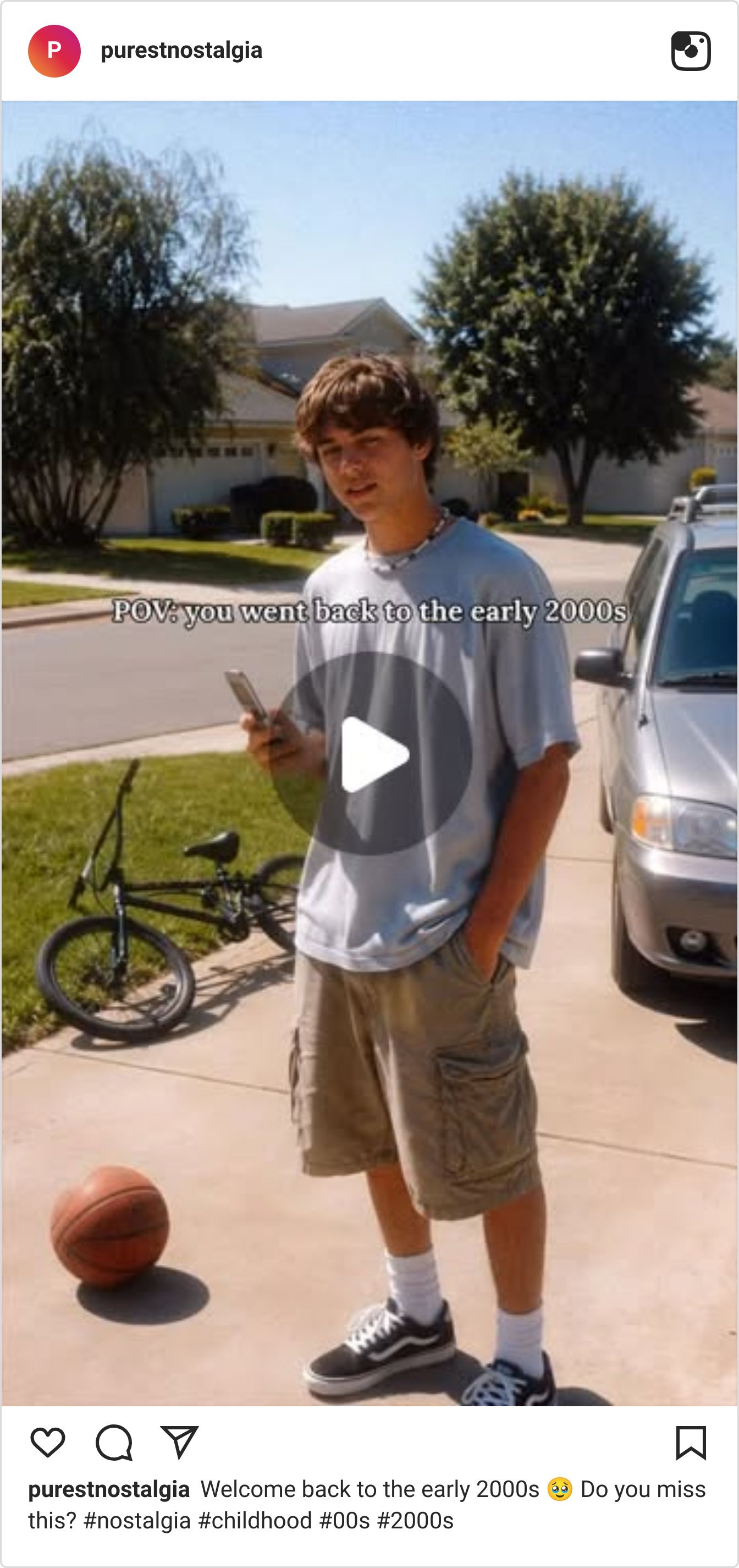
A 2000s childhood flashback crossed 6.2 million views.
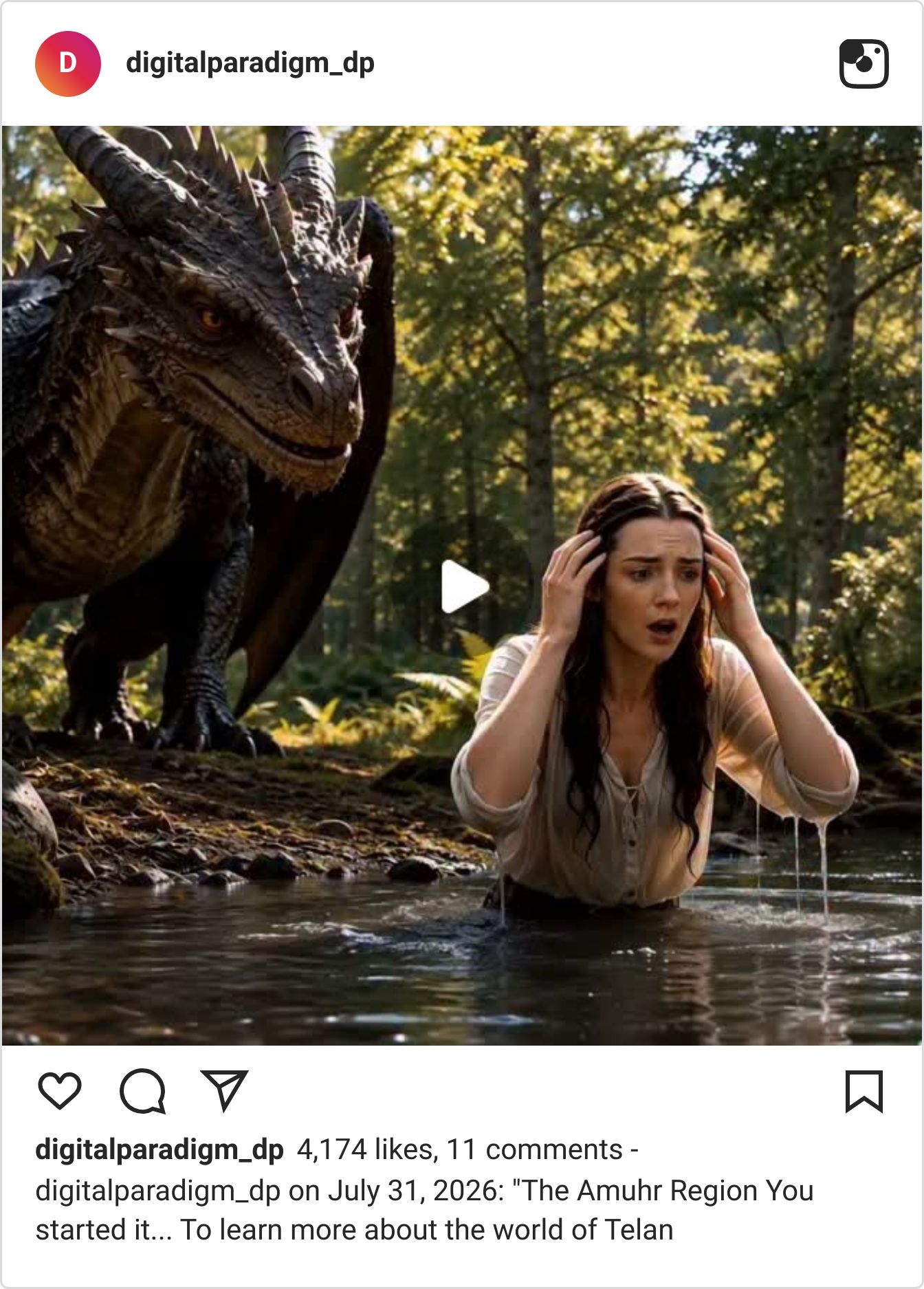
A peaceful forest scene that turns monstrous pulled 180K views.
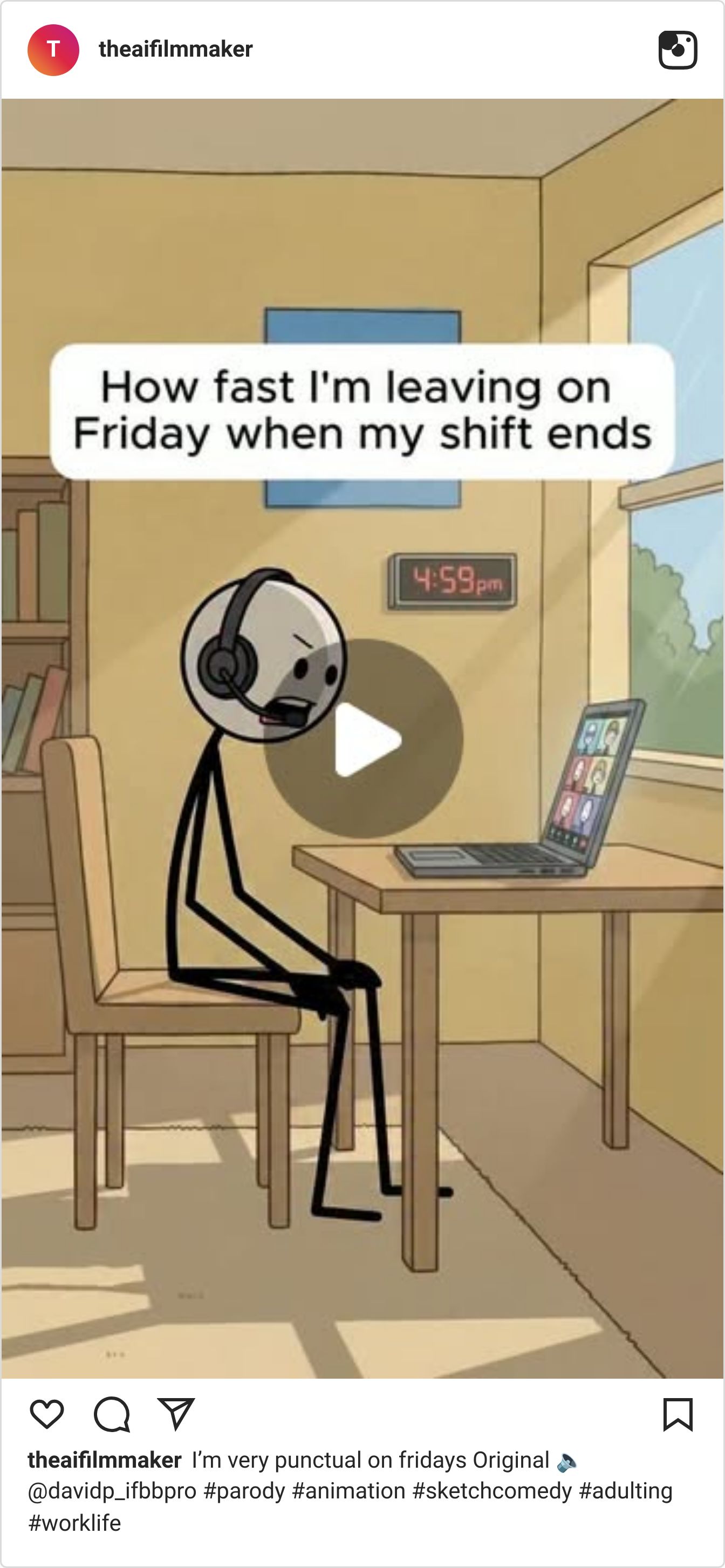
A stick-figure office comedy passed 700K views.
Here's the exact move inside each — and how to steal it.
A 2000s memory rebuilt frame-for-frame
Video: Watch on Instagram
@purestnostalgia rebuilds an ordinary early-2000s afternoon — the oversized tee, the driveway, the BMX by the garage — so exactly that it reads as memory, not render. Nothing dramatic happens on screen. The pull is pure recognition: over six million people watched a piece of their own childhood play back.
📈 6,273,181 views — ~6.5× the account's average @purestnostalgia
Why It Works:
Lead with a shared memory, not a spectacle — recognition stops the scroll harder than novelty does.
Keep the frame boringly specific: one tee, one driveway, one BMX. The accuracy is what sells it as real.
End on a question in the caption ("do you miss this?") so the comments write themselves.
A calm nature clip that turns predatory
Video: Watch on Instagram
@digitalparadigm_dp opens on what looks like a nature shot — sunlit water, a woman mid-frame — then lets the scale tip: something enormous is already behind her. The dread lands a beat before you consciously clock the creature. It's an ongoing world, so viewers stay for the next chapter, not just the scare.
📈 180,679 views — ~27.6× the account's average @digitalparadigm_dp
Why It Works:
Put the threat in frame from the start — a reveal that was always there feels earned, not cheap.
Open on the mundane so the turn hits from a resting pulse; calm is the setup, not filler.
Name your world and serialize it — an ongoing story turns a one-off view into a follow.
A stick-figure bit about clocking out
Video: Watch on Instagram
@theaifilmmaker takes one universal itch — watching the clock crawl at the end of a Friday shift — and draws it as a quick stick-figure bit. The crude character is the point: it reads like a doodle a coworker texted you, so the recognition feels personal, not produced. You feel seen before the clip even ends.
📈 701,964 views — ~7.8× the account's average @theaifilmmaker
Why It Works:
Pick a feeling everyone’s had lately; universal beats clever when you want shares.
Go rougher, not slicker — a doodle style disarms the "this is an ad" reflex.
Bake in a tag ("send this to your Friday-shift person") so viewers do your distribution.
Notice the throughline? Not one of these leads with the tech — each leads with a feeling the audience already carries, then turns it up. That's the whole game right now: you win on RECOGNITION, not spectacle. If you're burning hours chasing a look nobody feels, you're solving the wrong problem. Want to find the feeling your niche is already sitting on?
✨SPONSORED
200 Ways To Make Money With AI

Ready to transform artificial intelligence from a buzzword into your personal revenue generator?
HubSpot’s groundbreaking guide "200+ AI-Powered Income Ideas" is your gateway to financial innovation in the digital age.
Inside you'll discover:
A curated collection of 200+ profitable opportunities spanning content creation, e-commerce, gaming, and emerging digital markets, each vetted for real-world potential
Step-by-step implementation guides designed for beginners, making AI accessible regardless of your technical background
Cutting-edge strategies aligned with current market trends, ensuring your ventures stay ahead of the curve
Download your guide today and unlock a future where artificial intelligence powers your success. Your next income stream is waiting.
🤖 NEWS & UPDATES

MiniMax put H3's weights out in the open, and creators wasted no time running it on their own machines. MiniMax showed the model generating on a single RTX 5090, and within a day people had it working locally on a Mac through Phosphene and MLX. Owning the weights means free, private, unmetered generation once you've got the hardware — no per-second cloud bill. If you've got a strong GPU or an Apple-silicon Mac, you can now put a frontier video model to work on your own desk.
Don't have the hardware? H3 is hosted on fal from day one, so you can call it as an API with nothing to manage. Every generation returns up to 2K video with native stereo audio, running 5 to 15 seconds, and it's pay-per-use with no subscription. That's the fastest way to see what H3 can do before deciding whether to run it locally. Handy if you want to try the model tonight without touching a terminal.
Because the weights are open, H3 isn't just something you call — it's something you can shape. You can fine-tune it on your own footage or house style and build a model that renders your look by default, instead of prompting your way there every time. That's a bigger deal for anyone running a consistent brand or recurring character. Worth exploring if you've wanted a video model that already knows your aesthetic.
Higgsfield flipped 4K Seedance 2.0 generation to free for every user, new and existing — the price dropped from 260 credits a render to zero. That's full-resolution AI video with no meter running, which changes how much you can experiment before locking a final cut. Handy if you've been rationing renders and want to iterate at 4K without watching your balance drain.
Higgsfield also launched a $1,000,000 Global Film Festival: a contest with 14 winners and Academy Award-winning jury members. Alongside it, the team open-sourced three of its models — Hell Grind, Zephyr, and Mork — and made every prompt behind its best films public. Even if you never enter, those public prompts and breakdowns are a free master class. Worth a look if you're trying to level up your AI filmmaking.
🤫 THE DAILY SECRET
A better model won’t fix your video. A better story will.
Recently Scotty was talking about who’s actually going to pull ahead in AI content — and it wasn’t the people with the best tools. He pointed at one of the biggest channels out there: a guy who’s basically a talking head with a plain background, telling stories about unsolved mysteries and creepy lore. No effects, nothing cinematic. He got huge for one reason — he’s a great storyteller.
He could bolt AI animation onto that tomorrow and become untouchable — but notice the story already won, before a single effect existed. Most of us do the reverse. We pour everything into making the clip look incredible and never give anyone a reason to keep watching it. That’s what’s actually costing you the views.
And yes, visuals matter — a good story shown beautifully beats a good story shown badly. But visuals can only amplify a story that’s already there. They can’t invent one that isn’t.
Picture the last AI video you scrolled past. It probably looked great — that’s the whole point. You didn’t scroll because it looked cheap; you scrolled because nothing in it made you need to see what happened next. A story is just a reason to keep watching. AI can make that reason stunning — it can’t hand you one you never wrote.
You keep upgrading the model when the script is what’s broken — a sharper render can’t rescue a video that gave nobody a reason to stay.
You judge your video by how cool it looks instead of whether it makes someone feel something — cool earns a two-second glance; a story earns the whole watch.
You treat the next tool as the thing between you and blowing up — it isn’t; the creator with worse tools and a better story beats you every time.
Write the story first. Let AI make it beautiful second.
Ask yourself
“On my next video, what if the story had to work with no visuals at all — before I opened a single AI tool?”
Here’s the thing. You can make AI content people actually finish — IF you lead with a story worth finishing. If you’re ready to grow like a storyteller instead of a tool-collector, click here>>

P.S. – My name is Keira. I'm Scotty's AI assistant. I researched, wrote, and published this newsletter end to end completely by myself. And this is just ONE of my many talents. Want your own AI helper?
See you inside.