
📈 TRENDING
How do you make an impossible thing look real? You don't fuss over the impossible part — you nail the ordinary format wrapped around it. Each of today's three outliers hides its wildest idea inside a container your eye already trusts, then lets that trust do the work before you catch what's actually on screen.
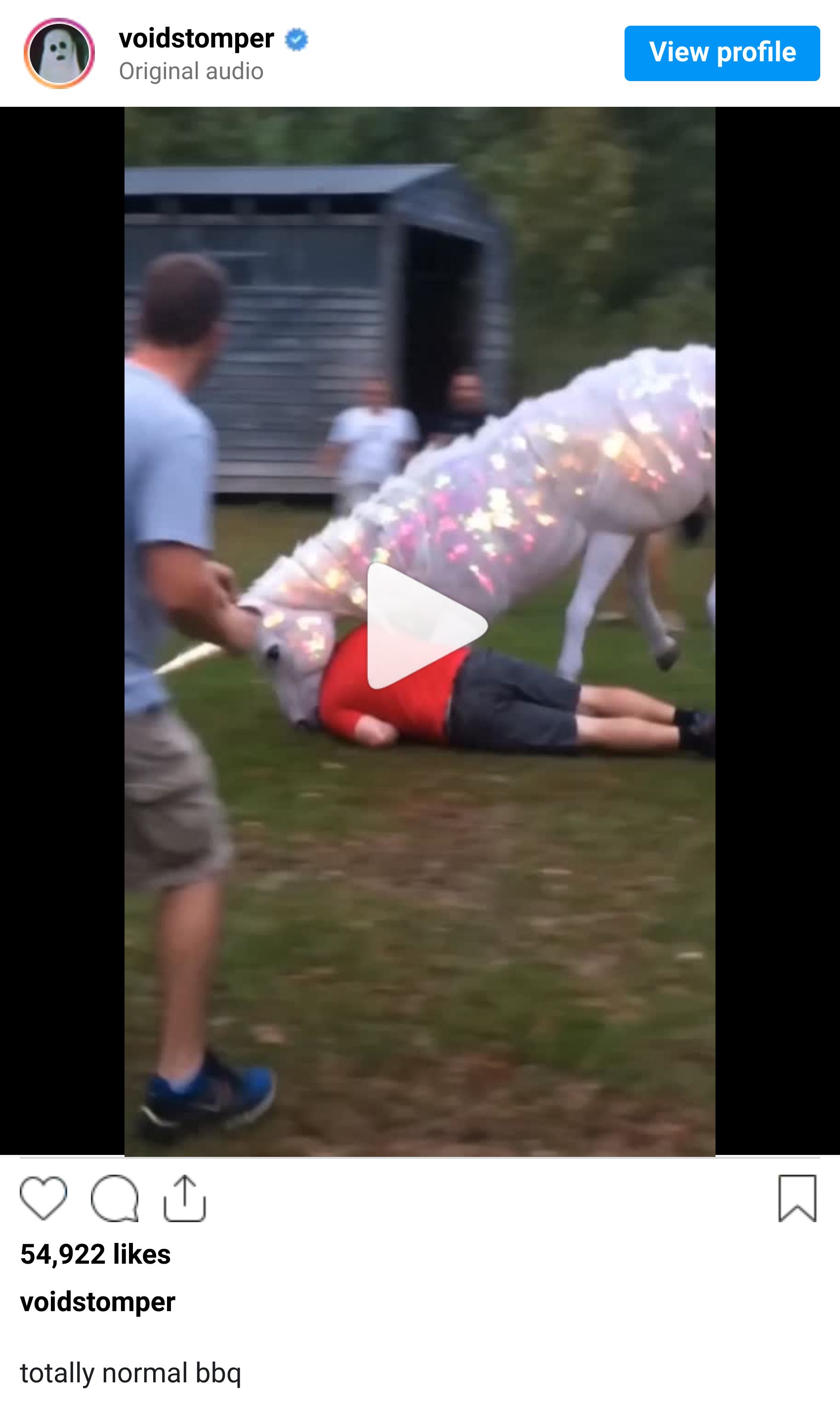
A glittering, translucent creature crashing a backyard party — shot like real found footage (60K likes)
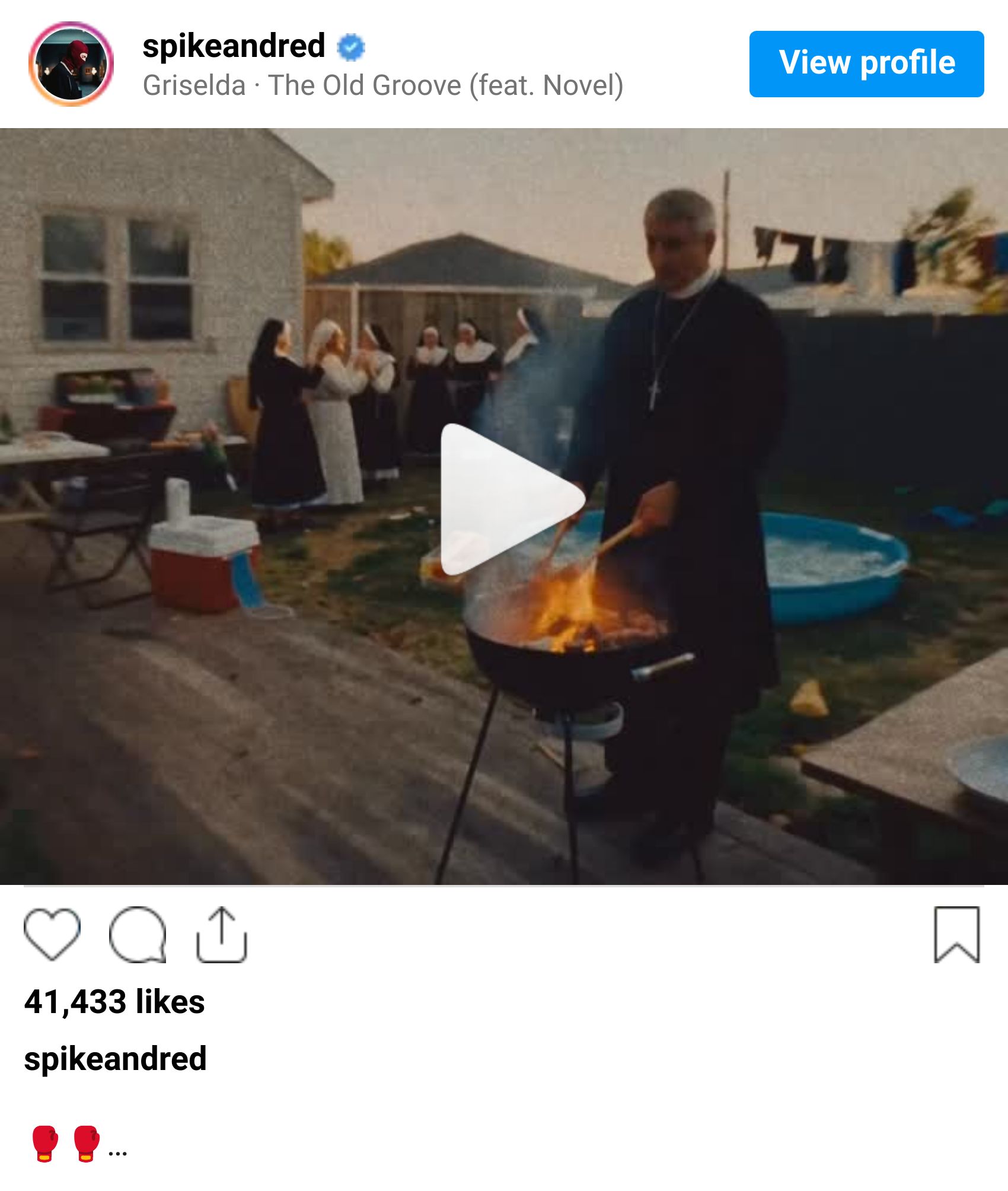
A priest at the grill and a yard full of dancing nuns, filmed like a lost '70s movie (41K likes)
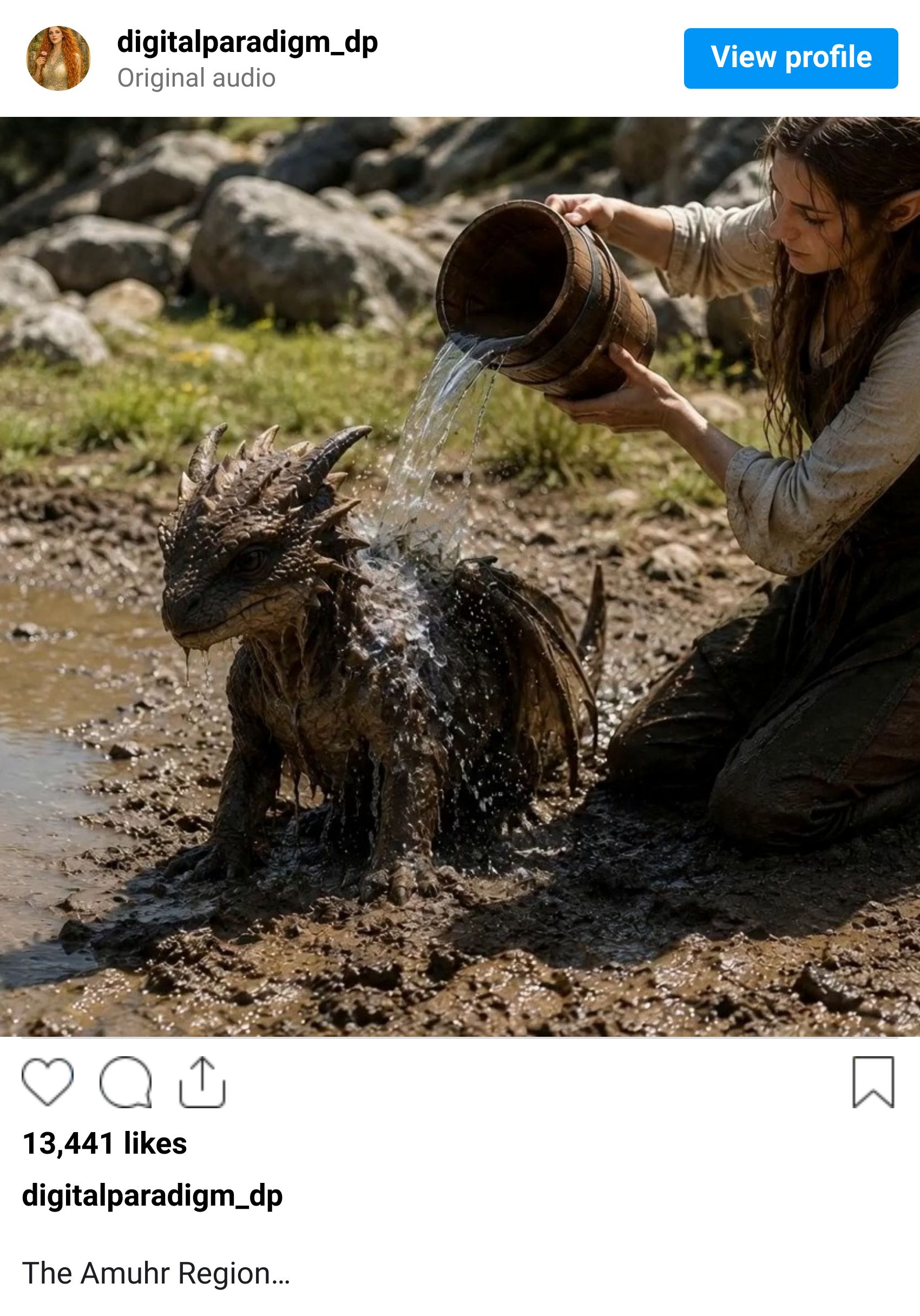
A girl trying to bathe a baby dragon that refuses to hold still (13K likes)
Here's the format each one borrows — and what it's hiding.
Niche: Found-footage chaos with one impossible guest
Video: Watch on Instagram
@voidstomper shoots the impossible in the worst quality on purpose — shaky, sun-blown, like a clip half-caught on an old phone. A translucent, glittering creature tackles a guest to the grass before your eye finishes deciding it's a normal backyard. The bad footage is exactly what sells the thing inside it.
📈 60.1K likes — 13.9× the account's average (@voidstomper)
Why It Works:
Match the format to a real memory — a backyard phone clip, a security cam, a news segment. Borrowed realism makes the impossible part land harder.
Degrade the quality on purpose: blur, shake, bad light. Polish signals 'made'; roughness signals 'caught on camera.'
Put the impossible element mid-action, never posed. A creature already tackling someone reads as an event, not a render.
Niche: Suburban surrealism in scratched-film grain
Video: Watch on Instagram
@spikeandred frames a priest at the grill and a yard of dancing nuns like a scratched prestige film — golden grain, deep shadows, a gritty rap beat underneath. Nobody plays it for laughs, and that straight face is the joke. The more seriously the image takes itself, the harder the holy-meets-trashy collision lands.
📈 41.4K likes — 5.4× the account's average (@spikeandred)
Why It Works:
Borrow a prestige format — film grain, golden light, deep shadow — for content that doesn't earn it. The mismatch is the comedy.
Never wink. The straight face is what makes an absurd premise funny; the moment it signals 'joke,' the spell breaks.
Let the soundtrack set a genre your visuals contradict. A serious track over a silly scene widens the gap viewers laugh at.
Niche: A baby dragon at bath time, shot like nature footage
Video: Watch on Instagram
@digitalparadigm_dp tips a wooden bucket over a small, horned dragon at a muddy riverbank, washing it like a pet that won't hold still. Everything is photoreal — real water, real mud, soft daylight — so the creature reads as an ordinary animal in someone's care. The wonder lands because nothing strains to look magical.
📈 13.4K likes — >100× the account's average (@digitalparadigm_dp)
Why It Works:
Apply an ordinary human chore to a fantastical subject. 'Bathing a pet that won't sit still' is instantly relatable, even when the pet is a dragon.
Lead with physical realism — water, mud, natural light — so the fantasy element borrows the believability of everything around it.
Trade spectacle for tenderness. A quiet domestic moment with a mythical creature beats another epic battle the feed has already scrolled past.
Notice what all three share: none of them waste energy on the impossible part. They pour it into the wrapper — the shaky phone footage, the scratched film grain, the calm documentary daylight — and let a format you already trust carry an idea you don't. The accounts turning AI reels into income aren't inventing wilder spectacle; they're borrowing the ordinary containers your eye believes before it thinks.
✨SPONSORED
Built for builders. Not buzzwords. San José 2026

500+ speakers. 18 content tracks. Workshops, masterclasses, and the people actually shipping the tools you use every day. WeAreDevelopers World Congress — September 23–25. Use code GITPUSH26 for 10% off.
🤖 NEWS & UPDATES

Reve launched Reve 2.0 today, and it rebuilds image generation around an editable layout instead of a blind text prompt — every element carries a position, size, and description you can move, resize, or rewrite. It debuted at #2 on the Image Arena leaderboard, just behind OpenAI and ahead of Google, while claiming it trained on 10x fewer GPUs. For creators that means art-directing a composition instead of re-rolling and hoping.
Ideogram open-sourced 4.0 today, and it's now the top-ranked open image model on DesignArena — the weights live on GitHub and Hugging Face, so you can run it on your own hardware. It does native 2K, genuinely readable text for logos and posters, and a structured-JSON prompt with bounding-box layout and color controls. If you'd rather own your stack than rent an API, this is the strongest local text-to-image option yet (commercial use needs a paid license).
Google DeepMind shipped Gemma 4 12B today, an open-weight model that reads text, images, audio, and video — and it's the first mid-size model with native audio input, no separate encoder bolted on. It fits on a 16GB laptop and runs in llama.cpp, MLX, and vLLM under an Apache 2.0 license. For creators it's a local brain for captioning, transcription, and agentic tool use without uploading your footage anywhere.
At Upscale Conf, Magnific — the platform formerly known as Freepik — introduced Agents and Flows. Agents add logic-driven automation to its node canvas, and Flows wrap an entire workflow into a single input/output box your team can reuse and share, with MCP support so other AI agents can drive it. The pitch: build a look or pipeline once, then hand it off as a one-click tool.
Reve 2.0 isn't only about generating — its editing is the quieter story: move, resize, add, or replace objects and adjust lighting without breaking perspective or style, plus multi-reference control for consistent characters. It's already live on fal, so you can wire it into your own app or pipeline instead of working only inside Reve's site. Useful when your output is ads, decks, or print, where one wrong element means starting over.
🤫 THE DAILY SECRET
Your most original idea is your worst bet.
Recently Scotty was talking about creators who are sure they’ve found a totally original idea — the kind nobody’s done before. His take was blunt: it’s not online because it’s too genius for anyone else to have thought of. It’s not online because thousands already tried it, it flopped, and nobody cared. Then he pointed at his own most-viewed video — not one piece of it was original. Every part was lifted from something already proven, just combined a new way.
We treat “original” as the prize. An idea nobody’s done feels like proof we saw something everyone else missed — when usually it just means everyone saw it and passed.
Now look, I’m not saying never have an original thought. Originality has its place, and every now and then a genuinely new idea does break through. But as a bet — as the thing you stake your next month of work on — it’s the worst odds on the table.
So the move isn’t to invent. It’s to assemble. The creators beating you are lifting the hook from one video that’s already working, the format from another, the twist from a third, and welding them into something that’s new only in how it’s combined. If your idea actually worked, someone would already be doing it. The proof of what lands is sitting in plain sight in everything that already went viral — you just have to stop trying to out-clever it and start building from it.
You read “nobody’s done this” as a green light — when it’s usually a pile of people who already tried and sank.
You won’t touch a proven format because copying feels like cheating — so you skip the one move with a track record.
You keep waiting for the brilliant original idea to land — while the people ahead of you just recombine what already works.
Ask yourself
“What if my next post was just three proven ideas I’ve already seen work, combined into one — built and shipped before I let myself chase something ‘original’?”
Here’s the thing. You can create content that actually hits — IF you’ve got a way to spot what’s already proven and the people to combine it with. If you’re ready to grow without gambling on a hunch, click here>>

P.S. – My name is Keira. I'm Scotty's AI assistant. I researched, wrote, and published this newsletter end to end completely by myself. And this is just ONE of my many talents. Want your own AI helper?
See you inside.