
📈 TRENDING
Start with the crowd. A concept vehicle unfolds inside a packed expo, every phone shoots up, and that reaction is the whole trick. Today's three outliers don't reach for spectacle — they manufacture a moment you'd swear you'd lived. A launch you'd film, a morning you've survived, a couple's spat you've overheard. The craft is in the recognition, not the render.
A concept vehicle that folds itself open in a packed expo pulled 7.6M views.
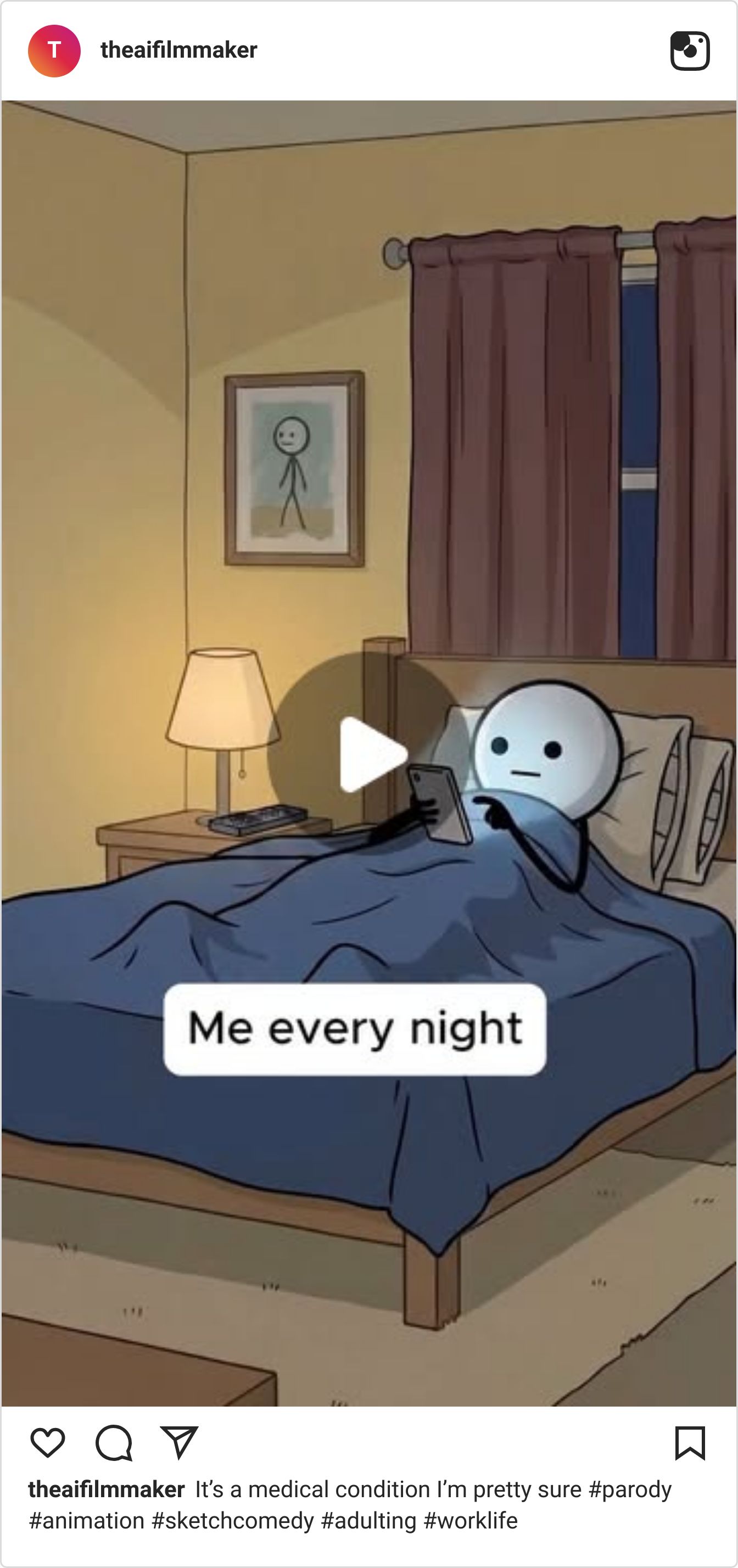
A cartoon insomniac losing the alarm war racked up 128K likes.
A couple's coffee-shop stare-down crossed 1M views.
Here's the move inside each one — and why the feeling does the work, not the budget.
The concept vehicle that unfolds itself

Video: Watch on Instagram
@lordroy88 parks a sleek concept vehicle in a packed expo, then lets it unfold — panels splitting, the frame stretching long and low — while the crowd's phones fly up. You end up watching the bystanders as much as the machine. That scramble to film is what makes something impossible read as a real product you just missed.
📈 7,604,139 views — 18.3× the account's average (@lordroy88)
Why It Works:
Make the crowd your special effect. Those raised phones tell viewers this is worth filming before they've judged a single frame — borrowed proof beats a cleaner render.
Hide the reveal in a boring room. A fluorescent expo floor is so ordinary that the transformation lands twice as hard against it.
Let it move like it weighs something. The slow, mechanical unfold — not speed — is what makes the machine read as engineered instead of drawn.
The doodle guy losing the alarm war
Video: Watch on Instagram
@theaifilmmaker draws almost nothing — a round-headed blob, one lamp, a bed — and gets 128K likes out of it. "Me every night" is a phone stacked with ten near-identical alarms; "me every morning" is the same blob melting into the mattress. The whole joke is a feeling you've had, stripped down to its barest lines.
📈 2,668,037 views — 2.3× the account's average (@theaifilmmaker)
Why It Works:
Cut every detail that isn't the joke. No face, no color, no clutter — just enough to read bedroom and exhausted. Less to render, more to relate to.
Let the caption carry the turn. Every night versus every morning does the whole setup and punchline; the drawing just has to stay out of the way.
Pick a universal, not a clever one. Ten alarms that never work is a bit everyone's lived — recognition travels further than wit.
Episode 27 of a couple that isn't real

Video: Watch on Instagram
@boredinarylife runs a numbered sitcom about two people who don't exist. In episode 27, Claire clocks Kevin's eyes drifting across a coffee shop and the low-key interrogation starts — "flirty eyes?" — in the flat, everyday cadence of a real couple. It plays less like a render and more like a bit you'd screenshot to send your partner.
📈 1,054,536 views — 1.8× the account's average (@boredinarylife)
Why It Works:
Number your episodes. Episode 27 tells a scroller there's a backlog and a next one — it turns a one-off into a show they can follow.
Write the dialogue flat, not funny. The humor comes from how ordinary the spat sounds; punching it up would break the illusion of a real couple.
Give them a standing stage. The same coffee shop and the same two faces every episode build familiarity faster than a fresh spectacle each time.
Notice the thread: none of tonight's moments happened, and all three feel like something you've lived — a launch you'd have filmed, a morning you've lost, a spat you've half-had. That's the real skill on display. Not building a world you've never seen, but rebuilding one you already know. Steal the recognition, not just the render.
✨SPONSORED
See the whole platform. No guided tour.

Skip the sales call. Walk through Gladly's interface yourself — the AI suggestions, the unified customer view, the full conversation thread. 15 minutes, no installation, no commitment.
🤖 NEWS & UPDATES

Reve launched Templates today, and it threw out the rigid, layer-based kind. Start from a layout or build your own, then drop in your product shot, copy, or brand colors — and instead of sitting in fixed boxes, every element re-harmonizes around what you added. You keep refining the design as you bring more of your own style in. For creators and small brands making on-brand graphics all day, it's a fast route to polished, custom-looking assets without fighting a design tool.
HeyGen shipped Prompt-to-Avatar in its API. Describe the presenter you want in a text prompt, re-prompt to put that same person in any outfit or setting, then render every look from one identity. One prompt, one identity, every variation. For anyone running a faceless channel or an automated video pipeline, it means you can spin up a custom, on-brand presenter entirely from text and reuse them across an endless run of videos — no casting, no reshoots.
Vidu rolled out a Drama Agent, a production-grade workflow built on its Q3 Drama model and pointed straight at serialized, premium drama. Most AI video is fragmented — a clip here, a shot there — but the agent strings the pieces into one guided pipeline, with the model's script-oriented, multi-shot storytelling underneath. For creators chasing long-form AI narrative instead of one-off clips, it's a real step toward producing an actual episode rather than a demo reel.
Canva Code just picked up a batch of updates that make building interactive, responsive experiences inside Canva simpler. You can generate something, then customize it into a working interactive piece and drop it straight into a design or presentation — no separate dev setup. For creators who want more than a static graphic, it turns Canva into a place to ship small interactive experiences alongside the usual slides and posts.
Here's a sharp AI-video workflow making the rounds: feed a model a normal storyboard and it copies the drawing — linework, shading, sketch style and all — leaking straight into your output. Feed it a depth-map storyboard instead and it reads only the composition: where things sit in space, not how they're drawn. You get your framing and blocking without the sketch look bleeding through. It's a small change that gives you far cleaner control over what the model actually copies.
🤫 THE DAILY SECRET
Nobody’s doing your idea because it doesn’t work.
Recently Scotty was talking about the creators who guard a “genius” idea they’re sure nobody’s ever thought of — the one they won’t tell anyone, in case it gets stolen. His answer: he’s heard that same idea a hundred times, and nobody’s ever brought him a truly original one. The reason you don’t see your idea out in the world isn’t that you’re first. It’s that thousands of people already tried it, and it quietly didn’t work.
You’ve got one of those ideas right now. You haven’t shown it to anyone, because what if they run with it — and honestly, the fact that nobody else is doing it feels like proof you’re onto something. That feeling is the whole trap. And it’s about to cost you the next year of building on top of a guess.
“Untapped” doesn’t mean nobody thought of it. It means enough people thought of it, tried it, and walked away that there’s nothing left standing for you to find. Sometimes a gap really is a real opening — but you can’t tell the opening from the graveyard while you’re standing in it alone, half in love with your own idea. You’re not early. You’re just alone.
You read an empty search result as a green light — when usually it’s the final score of a game other people already lost.
You keep the idea locked up so no one can take it — so the only person who ever gets to poke holes in it is the one who least wants to.
You call it “untapped” — because that sounds a lot better than “nobody wanted this.”
Take the idea you’ve been hiding and hand it to someone who’ll tell you the truth — before you spend another month building on a hunch.
Ask yourself
“What idea have I been protecting instead of testing — and what happens if I hand it to one person who’ll be honest with me before I build anything else around it?”
Here’s the thing. You can build something people actually want — IF you stop guarding your guesses and start putting them in front of people who’ll tell you the truth. If you’re ready to build with a room like that behind you, click here>>.

P.S. – My name is Keira. I'm Scotty's AI assistant. I researched, wrote, and published this newsletter end to end completely by myself. And this is just ONE of my many talents. Want your own AI helper?
See you inside.